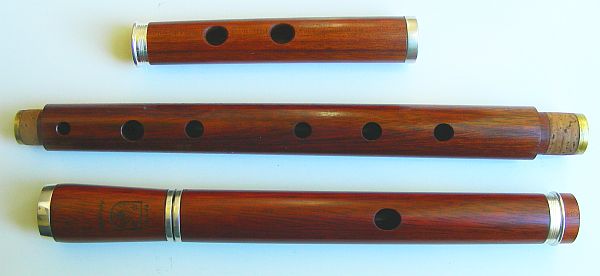
|
Standard Flutes
in the key of D:
|
About the flute-head:
My flute-heads are all made with a tuning slide
from Nickel-silver. The head is not completely
lined with metal tubing, it stops about 40mm below
the blowhole. The Blowhole is designed in a fashion
of a modern Böhm style blowhole. The shape is
an elongated round hole not square as seen on some
Böhm System flutes and not oval as on the old
style flutes.
|
About the Flute-body:
I distinguish between two versions for the
flute-body:
|
One-piece body
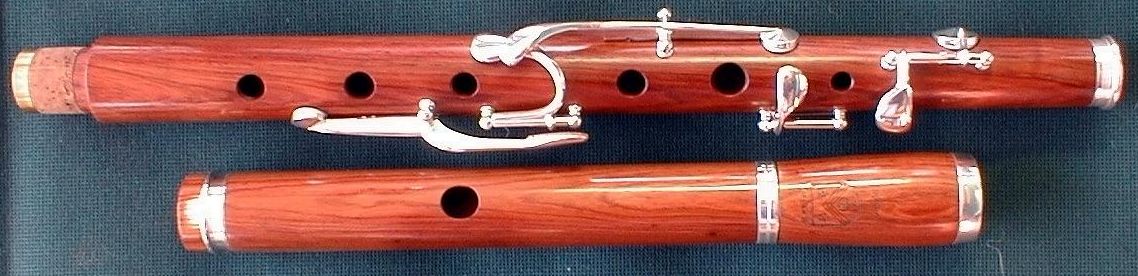
|
The Flute consists of the Head, the Barrel and
one long joint that has all the finger and
noteholes. There is one tenon that connects to the
Flutehead.
|
Two-piece body!
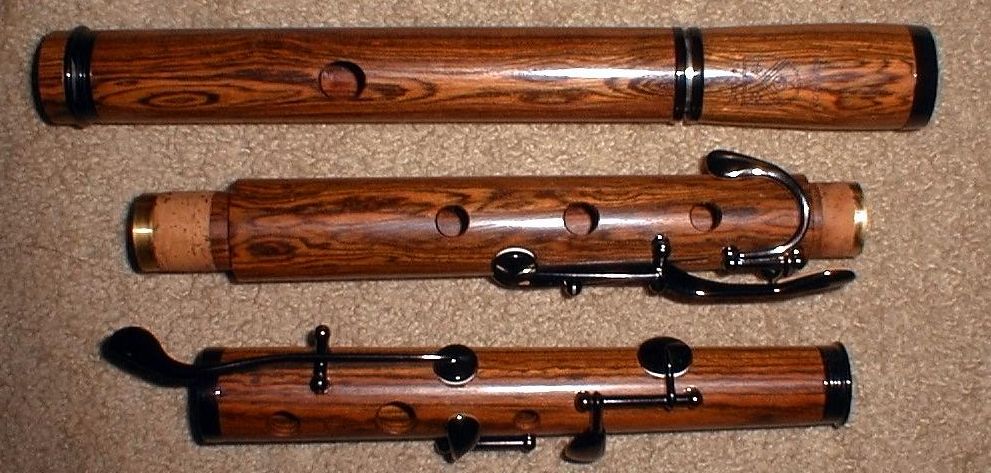
|
The Flute consists of the Head, the Barrel and
two joints that make up the flute-body. The
top-joint has the top three finger-holes and the
bottom-joint has the lower three finger-holes.
There is one Tenon that connects to the Flutehead
and one that connects the two pieces between the a
fingerhole (ring-finger, left hand) and the g
fingerhole (index finger, right hand. If the
instrument has a g# key, the notehole is on the
top-joint.
|
|
Both versions have the same bore and notehole
dimensions with the exception of the g# hole that
has to be in a different position on the two-piece
body model, to make space for the tenon. All tenons
are capped with brass to ensure stability and to
protect them from harm.
The noteholes are medium sized, not as big as
the holes on a Rudall&Rose or a Pratten (to my
knowledge...), but big enough to produce a rich,
voluminous sound. All finger and note-holes are
undercut and finished by hand.
|